The Thursday Murder Club's secret investigation of the buried remains
The Thursday Murder ClubThe Thursday Murder Club's secret investigation of the buried remains begins with an extra skeleton uncovered in a grave at the Garden of Eternal Rest and develops into an unofficial effort to establish who the man was, when he died, and why he was hidden there. The investigation is both a response to the remains’ unexplained presence and a race against the cemetery’s impending disturbance: the club fears that formal procedures could delay discovery while development proceeds, yet its decision to investigate privately leaves its members responsible for concealing evidence and breaking the law.
Discovery in the grave
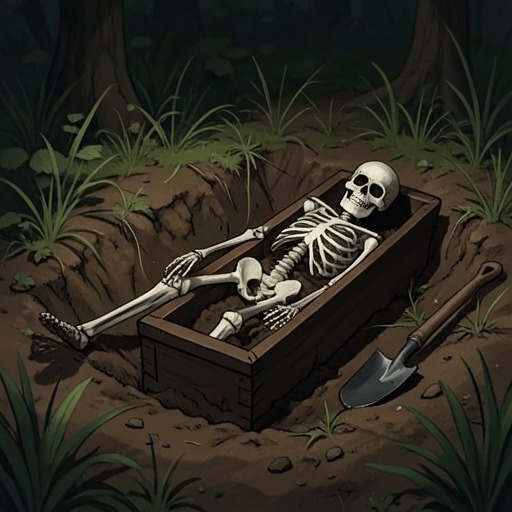
Bogdan is digging in the oldest part of the Garden of Eternal Rest, where trees shade the graves and the ground has remained undisturbed for many years. He expects the older coffins to be intact and works carefully, mindful that machinery could uncover graves quickly and without much care. When he finds bones, the discovery overturns his expectations. Rather than leave the grave and pretend nothing happened, he treats the remains as something he has a duty to protect and clears the earth by hand.
The grave contains two sets of remains: a skeleton outside the coffin and another inside it. Bogdan opens part of the coffin to confirm what he has found. The extra body raises an immediate puzzle. It cannot be explained simply as the expected occupant of the grave, and the possibility that someone had been buried alive briefly occurs to Bogdan before he sees the second skeleton within the coffin. The club’s investigation starts from this physical contradiction: a grave has been opened at some later time, another person placed inside, and the site closed again.
The discovery happens on the morning Ian Ventham is murdered. The coincidence makes the concealed remains relevant to the club’s questions about the more recent death, but it does not establish that the two events are connected. Joyce later frames the possibility as a question: whether someone knew the bones were hidden there, and whether Ian was killed to protect the Garden of Eternal Rest and its secret. At this point, that is a lead to test, not a conclusion.
An unofficial examination
Elizabeth and the others return to the grave to inspect it. Bogdan has borrowed an arc light to illuminate the site. Austin descends with Ibrahim’s help, taking care not to step on the bones scattered near the coffin. He examines a femur and assesses the remains’ colouration, distinguishing what can be observed from what can only be estimated. The bones appear to have been buried for decades, but the date carved on the original grave does not fit that assessment: the extra remains are not a century and a half old.
The examination also finds no jewellery or clothing associated with the extra skeleton. Austin considers that, if the burial resulted from murder, whoever placed the body there knew what they were doing. He takes some bones for closer examination. His findings later establish that the body was male and that its femur had a gunshot wound. He cannot say with certainty that the injury caused death; he judges it probably to have been an earlier injury. The distinction matters: the wound is evidence of a prior injury, not proof of how the man died.
Austin’s estimate places the burial in the 1970s, probably toward the beginning of the decade, roughly fifty years earlier. He bases the estimate on examination and calculation, while acknowledging the variables and uncertainty involved in dating bones. The club therefore gains a period in which to search, but not an identity, a cause of death, or a perpetrator. Scientific analysis narrows the mystery without resolving it.
The club’s choice and its cost
The club decides not to involve the police immediately. Elizabeth argues that the remains should first be identified and the person who buried them found, and that the police might take the bones into official custody before the club can learn more. The members’ wish to preserve access to the investigation is mixed with a sense that losing the evidence to procedure would be unfair after their work. Their confidence in their own inquiry does not make it lawful: Joyce recognizes that they have crossed a legal boundary, and that the presence of human remains calls for reflection rather than uncomplicated excitement.
The group’s mood shifts as Austin lays the bones on Joyce’s dining table. The excursion has felt like an adventure, and the members experience the giddiness of being part of something unusual; the remains bring home that someone died, however long ago. Austin is fairly sure the man was not a nun, ruling out one possible explanation without supplying another. The club’s next task is to establish when the man died, because a difference of decades could alter the inquiry. Its questions also reach back toward the unsolved death of Ian Ventham, though the connection remains uncertain.
When the club eventually tells Chris and Donna what it has done, Elizabeth offers them a practical way to proceed. She acknowledges that the members knew their actions were wrong, but argues that prosecuting four people in their seventies and eighties for failing to report an exhumation would be difficult and achieve little. She proposes that the officers forgive the group and order a search the next morning on a supposed hunch. The official search could then recover the remains and have the police’s own forensic team confirm that the skeleton was male and probably buried in the early 1970s.
The members have reburied the bones before this conversation, intending to give the police the credit for finding them. Ron even advises which grave to search first so the choice will not look too obvious. Their arrangement is a compromise: they disclose enough to put an official investigation in motion while withholding who opened the grave and who removed the bones for examination. The club’s private discovery is thus converted into a police search, but only after its members have tried to control how that discovery enters the official record.
A pattern of recovering old cases
The episode belongs to a broader habit of the club: returning to unresolved deaths through old records, physical evidence, and details others might overlook. In an earlier discussion, Elizabeth asks Joyce to consider the circumstances of a girl stabbed decades before. Penny’s squad car had carried the boyfriend to a police interview, but he escaped, struck Penny, and was never seen again. The club understands that revisiting such a case cannot magically secure justice. The buried man’s remains offer a different kind of opening: not a known suspect who has vanished, but a body whose very presence in the wrong grave proves that a past act has been concealed.
That commitment to old cases also appears in Elizabeth’s reliance on Penny’s stored files. Penny kept copies of cases despite not being supposed to retain them, in case they might help catch a killer years later. The files embody the club’s method: preserve information that might otherwise disappear, then revisit it when a later clue changes its significance. In the cemetery inquiry, however, the evidence is not a file alone but a disturbed grave, bones removed for analysis, and an uncertain date. The investigation’s force comes from joining these traces while acknowledging what they cannot yet prove.